Tuba Fingering Chart
Choose BBb, C, Eb, or F tuba, select a written concert-pitch note, and see the standard beginner valve combination instantly.
Choose tuba and valve system
Concert-pitch fingerings for the common four-valve BBb tuba beginner register.
Select Note
Open - no valves pressed
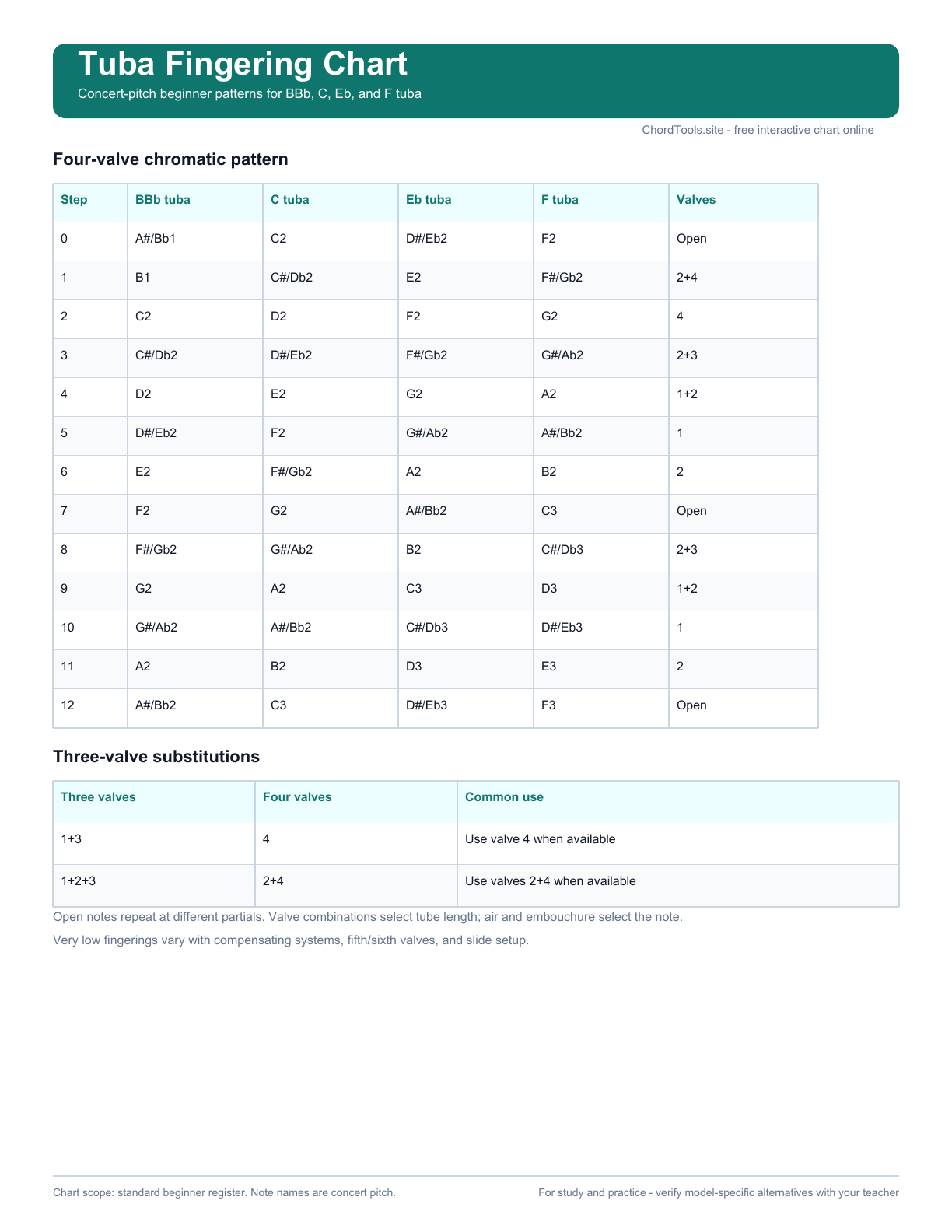
Free Printable Tuba Fingering Chart PDF
The printable reference groups the most common BBb, C, Eb, and F tuba patterns and clearly distinguishes three-valve and four-valve alternatives.
Download Tuba Chart PDFHow to Read a Tuba Fingering Chart
Filled valve circles are pressed. Open means no valves are down. The note names on this page are concert pitch, as normally read in bass-clef tuba music.
- Valve 1 lowers the open pitch by a whole step.
- Valve 2 lowers it by a half step.
- Valve 3 lowers it by roughly a step and a half.
- Valve 4 lowers it by a perfect fourth and often replaces valves 1 and 3.
Practice Valve Patterns With Centered Air
Say the note and valve numbers before playing, then move in half steps with a tuner. The same valve combination can belong to several partials, so hear the target pitch before starting the note.
BBb, C, Eb, and F Tubas
Tubas are built in several keys. A BBb tuba is common in school bands, while C, Eb, and F instruments are also used in orchestral, brass-band, and solo settings. Always select the chart that matches the instrument engraved or identified by your teacher.
When Low Tuba Fingerings Change
Very low notes depend on valve count, compensating design, fifth or sixth valves, and slide length. Treat this beginner chart as the standard starting point, then use the instrument maker's chart or a teacher for pedal-register alternatives and model-specific adjustments.
Tuba Fingering Questions
Is there a printable tuba fingering chart PDF?
Yes. The free PDF summarizes beginner valve combinations for BBb, C, Eb, and F tuba.
What does the fourth tuba valve do?
The fourth valve lowers the instrument by a perfect fourth and commonly replaces the sharp 1-3 combination. It also extends the usable low register.
Are all tuba fingerings the same?
The valve pattern is related, but the concert note produced depends on whether the instrument is in BBb, C, Eb, or F. Low-register alternatives also vary by model and compensating system.