Oboe Fingering Chart
Select a written note and see the main left-hand, right-hand, thumb, octave, and auxiliary-key pattern for a standard conservatory-system oboe.
Select Written Note
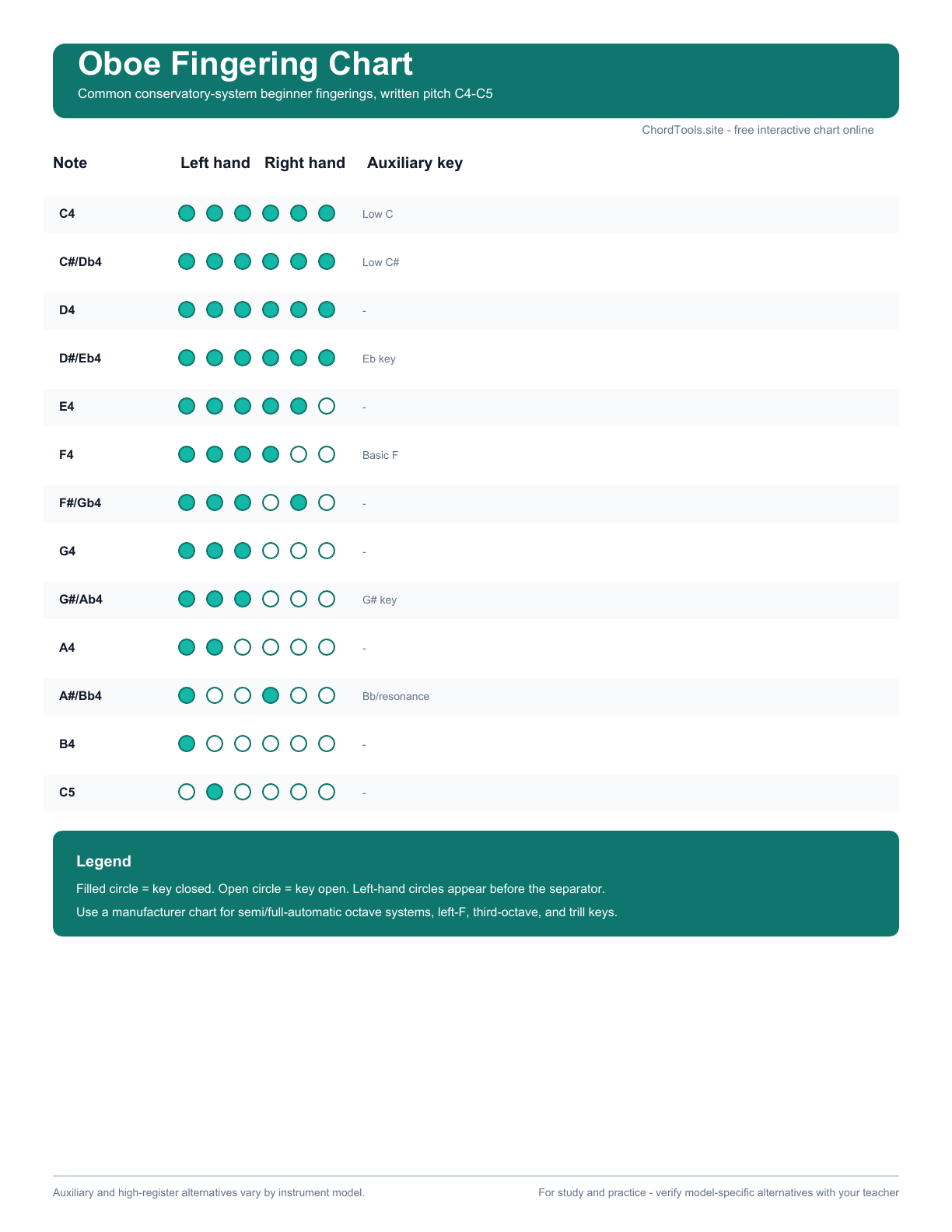
Printable Oboe Fingering Chart PDF
A clean beginner reference for common low and middle-register oboe notes, key symbols, and auxiliary-key reminders.
Download Oboe Chart PDFHow to Read an Oboe Fingering Chart
Closed circles indicate the main finger keys to press; open circles are released. Separate labels identify low-note, Eb, G#, and octave mechanisms that sit outside the six main fingers.
- Set the left thumb first, then the three left-hand fingers.
- Add the three right-hand fingers from top to bottom.
- Check the labeled auxiliary key before playing.
- Use the manufacturer's chart when your octave system or left-F mechanism differs.
Seal the Keys Before Increasing Speed
Oboe pads must close together cleanly. Practice each new fingering between one note below and one note above, keeping the fingers curved and close to the keys while the reed and air remain stable.
Semi-Automatic and Full-Automatic Oboes
Both systems share the main finger layout, but they coordinate octave keys differently. This chart uses standard beginner note shapes and names auxiliary actions rather than presenting one model's octave mechanism as universal.
High Notes, Trills, and Alternate Fingerings
Third-octave and trill fingerings are highly context-dependent. Learn the basic low and middle register first, then add model-specific high-note and trill charts with a teacher or manufacturer manual.
Oboe Fingering Questions
Is there a printable oboe fingering chart PDF?
Yes. The downloadable beginner PDF covers common written notes from low C through C5 on a conservatory-system oboe.
Why do oboes have alternate fingerings?
Alternate fingerings solve technical transitions, trills, tuning, and tone-color problems. Left F and forked F are common examples.
Do all oboes use exactly the same keys?
No. Semi-automatic and full-automatic octave systems, left-F keys, third-octave keys, and auxiliary mechanisms vary by model.