Alto Sax Fingering Chart
Learn beginner alto sax written notes with an interactive saxophone fingering guide and free printable PDF.
Select Note
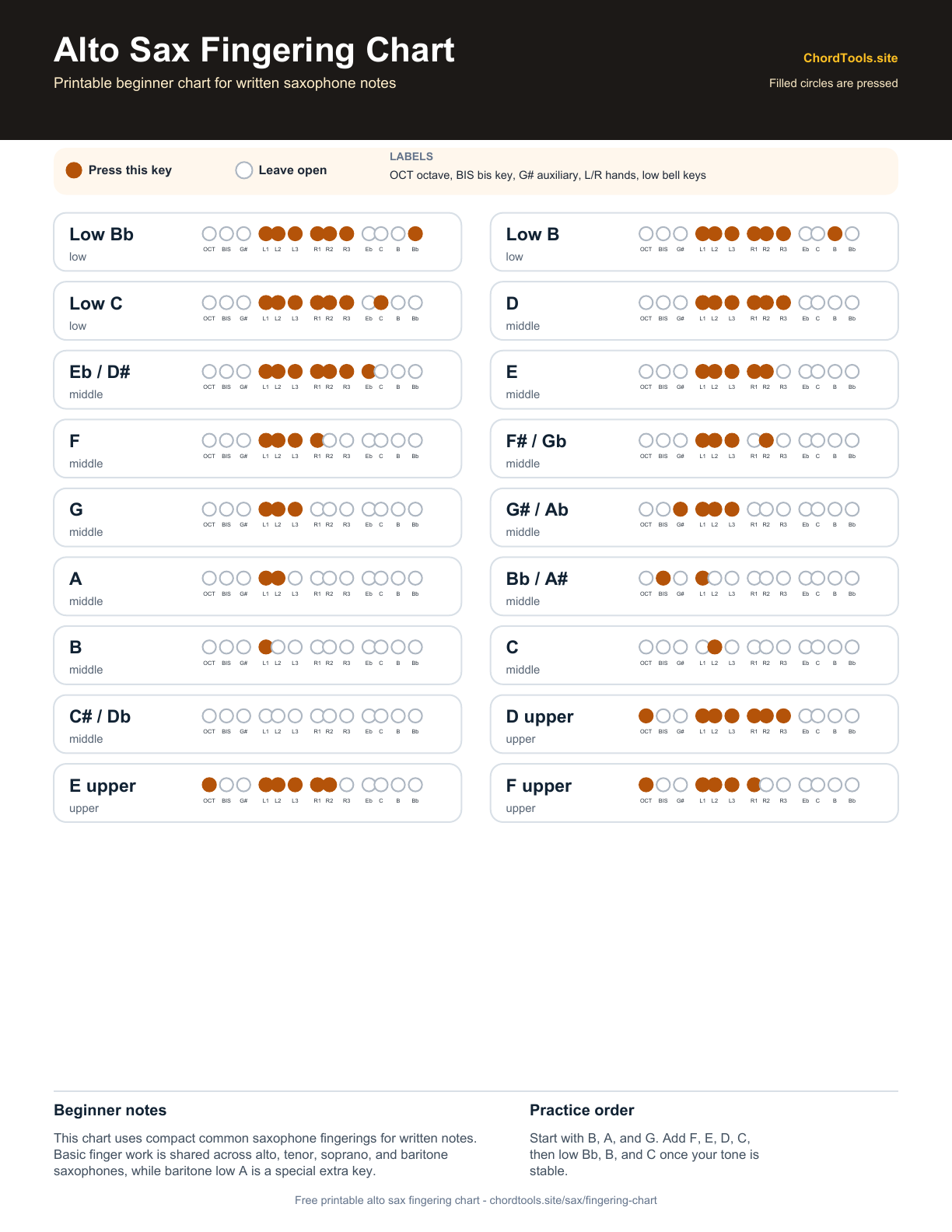
Free Printable Alto Sax Fingering Chart PDF
Download a one-page, black-and-white chart of 28 chromatic written notes from Bb3 to C#6, with labeled octave, bis, G#, low C#, and bell keys. Includes a key legend and register guidance.
Download PDFHow to Read a Sax Fingering Chart
A sax fingering chart shows which keys are pressed for each written note. This chart focuses on common beginner alto sax fingerings and keeps the layout compact for quick practice.
- Filled circles mean the key is pressed.
- Open circles mean the key stays open.
- Oct means octave key, used for the upper register.
- Bis and G# mark common left-hand auxiliary keys.
- Low C, B, and Bb are the lower bell-key fingerings.
Tips for Beginners
Start with B, A, and G, then add F, E, D, C, and the low notes. Use slow air, relaxed fingers, and a tuner to keep the pitch centered as you move between registers.
PDF Coverage and Printing
The free PDF covers 28 chromatic written notes, Bb3 to C#6. It uses the same note patterns as the interactive chart. Filled circles mean pressed keys or closed holes; outlined circles remain open. The diagrams are labeled key schematics, not to-scale pictures of the instrument.
Download the file or open it in your browser and choose Print. The chart is one US Letter page. For A4 paper, use Fit to Page; check the preview before printing. Black filled circles and larger key labels keep the chart readable in grayscale. No sign-up is needed.
Written Notes vs. Concert Pitch
The number in each note name identifies its octave: C4 and C5 are different notes, not alternate names for the same fingering. Use the written note in your saxophone part to select a diagram. Alto and baritone saxophones are Eb instruments; tenor and soprano are Bb instruments. Their basic written fingerings match, but a concert-pitch tuner will display a different note. Set the tuner to the right instrument before comparing its reading with this chart.
Low Notes and the Octave Key
Low B3 and Bb3 need the right-hand low C key as well as their left-hand bell key. Low C#4 combines low C with the left-hand C# key. Missing one of these keys can make a note fail to speak. From D5 through C#6, the chart adds the octave key to the basic first-octave pattern. Palm-key high notes above C#6 and altissimo are outside this chart; do not use the D5 pattern for high D6.
When to Use Bis Bb
The Bb4 and Bb5 diagrams use bis Bb: left index finger plus the small bis key, with the octave key added for Bb5. This is convenient when a passage avoids B natural. When moving repeatedly between Bb and B, a side-Bb fingering may be easier. This chart shows one useful fingering per note rather than every alternate. Ask your teacher to choose an alternate for the passage you are playing.
A Short Practice Routine
Play B4-A4-G4-A4-B4 slowly, keeping unused fingers close to the keys. Next, descend G4-F4-E4-D4, then return upward without changing your air abruptly. Finally, compare D4 with D5: keep all six main fingers down and add only the octave key. If a low note jumps up an octave, check that the octave key is released and the low-note pads seal before forcing more air.
Fingering References
Compare the standard patterns and consult these references for alternatives and notes beyond this chart.
Woodwind Fingering Guide: first octaveWoodwind Fingering Guide: second octave and palm keysCommon Questions
Is this chart for alto sax?
Yes. The page is optimized for alto sax beginners and uses written note names.
Do saxophones use the same fingerings?
For basic notes, alto, tenor, soprano, and baritone saxophones use the same core finger work. Baritone has an extra low A key on some models.
What does the octave key do?
The octave key helps the sax speak in the upper register while using many of the same main finger patterns.
Is this a full altissimo chart?
No. This beginner chart focuses on common low, middle, and early upper-register notes.